
|

|

|

|

|

|

|

|

|

|

|

|

|
|
|
|
|
|
|
|
|
|
|
|
|
|
|
|
|
|
|
|
|
|
|
|
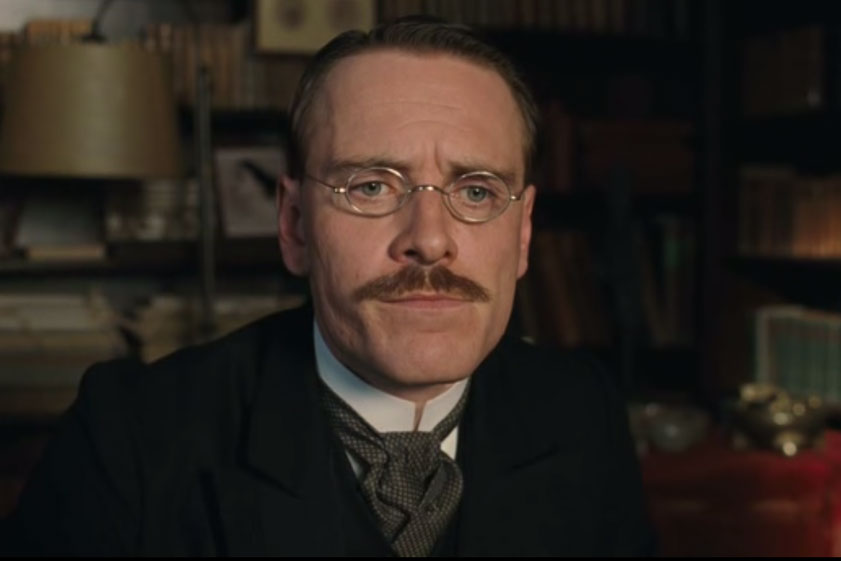
Q: What do you think Jung would have made of Brandon?
A: I think Freud would be more the man for him. But either would go through the history of the character and try to decipher where motivation starts. I would think that first and foremost Brandon has a problem with addiction. That's the thing, you know, how a pattern of behaviour starts to form itself into ones life, and that pattern of behaviour is damaging to you yourself, and the relationships in your life, and your workplace. That for me would be the definition of addiction. I think there's a very complicated character there.
What's interesting is that both films put our relationship to sex and one another under the microscope. Jung and Brandon are men of their time, I suppose, products of their environment and the society they're living in. But the two films are asking very similar questions.
Q: One thing that Jung shares with Brandon is a sort of emotional constipation.
A: Well, yeah. When we see Jung at this point in his life he is young, ambitious and feels he has a lot to prove in his field – and that comes with a certain insecurity. I think in his later life he became much more self-assured, and more free in terms of his moral dilemmas with sexuality and extra-marital affairs. Toni Wolf was his mistress later. She was also a former patient, like Sabina, but lived in the same house as Jung and his wife. Isn't that crazy?
Q: How did you approach Jung? No offence, but for me you almost play him like a bank manager, or an accountant?
A: Yes! Seriously, something you have to take into consideration is that he's Swiss. The Swiss embody their physicality differently than the French, the Italians, the English. He'd probably be more Germanic on the Swiss level, too, and that’s what I wanted to bring to him, a sort of Swissness which is very correct. He was a very physical man, in that he liked to take walks, and hikes in the country; he was a sailor. But everything was "just so", there's a ritual to the way he goes about eating, and working in his office and writing letters. I wanted him to be somebody with a dynamic that was moving forward, and somebody who on the outside appeared very much in control.
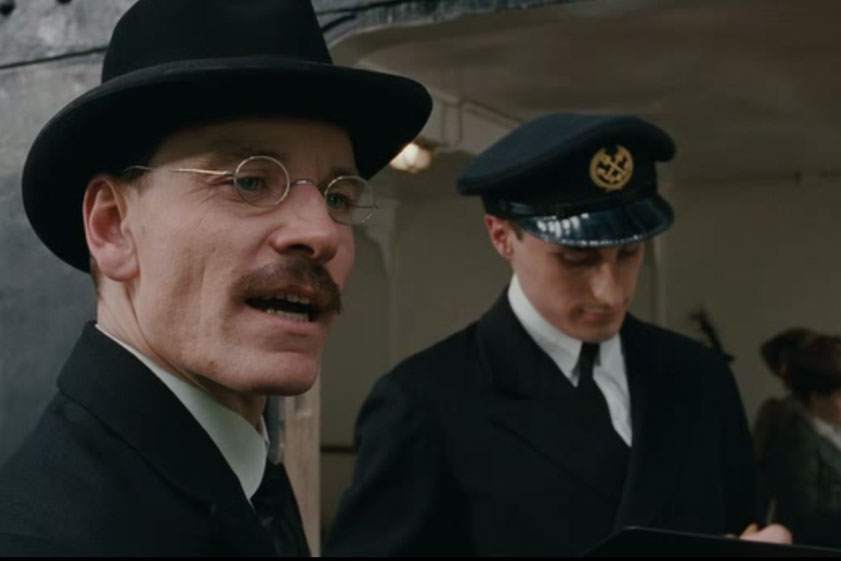
Q: Whose idea was it, yours or Cronenberg's, to keep Jung's shirt and tie on during the sex scenes?
A: I do remember David and I were talking about it on the day, and I think we mutually came to the decision that it would be something interesting to play with – to show that there is no abandon, there is something still holding him back. But if it's something that stands out it would probably be a specific idea of David's
Q: It's very comic of course.
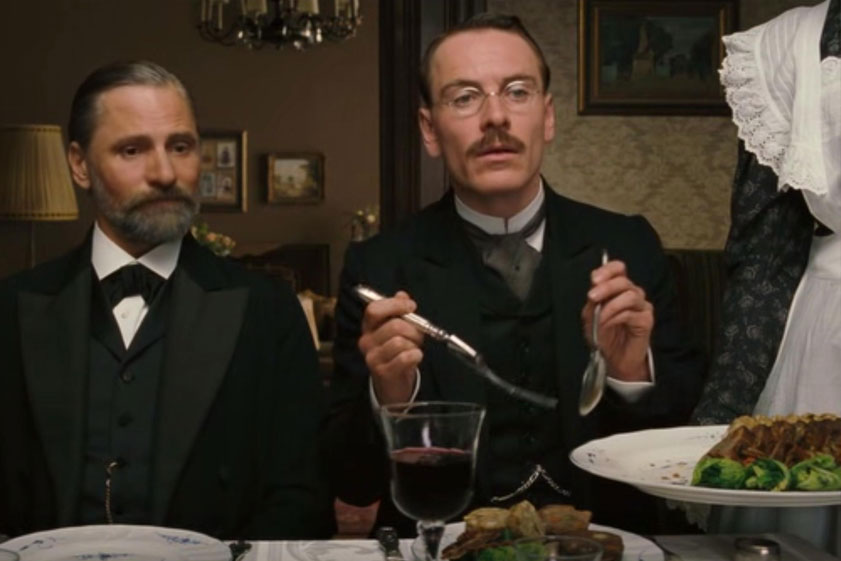
A: Absolutely. I thought the whole script was really funny, and wanted to play as much comedy as I could. Viggo and I really tried to push that together. We just couldn't help ourselves. We were doing that first scene where Freud says, "Do you realise we've spent 13 hours having this discourse?" And in between takes Viggo kept pushing these ceramic penises closer to my cup of coffee, till they were surrounding the cup. Then I took a sip and the cream is on my moustache – at one point it was on my nose and everywhere. So we were just trying to have fun with it. And thankfully David is open. He's been doing this long enough that he has the confidence and easiness to allow you to explore.
I do think people's behaviour in general is funny, isn't it? You know how when we get ruffled, or defensive, or we're inspired by something, the way the body reacts to that mental state – I think these things are funny. And I think if you can bring that humour to something that is dealing with an academic and intellectual subject, it allows the audience to relax; they recognise that "OK, this doesn't have to be a lesson". They can relax, and just watch these human beings, with their petty qualities and egos. I think it makes the work more accessible.
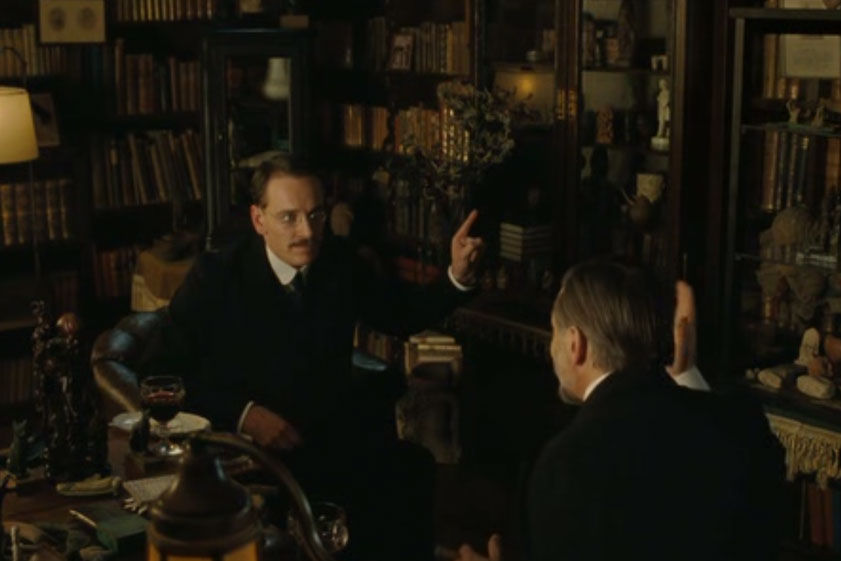
By the way, talking of the ceramics, I'm sure you noticed that Freud's study had all these symbols around the place, it's full of books, ornaments, Egyptian sort of stuff. And then you have Jung's, which is more about space. I thought that was really clever of David and the art department, really clever.
Q: I've heard many stories about Mortensen's dedication to a role, the way he turns up on set with his own props and the like.
A: I think it's the same with every film. People don't know when he's going to arrive, but it will always be before he's due on set. He gets off the plane, rents a car himself and turns up one day and starts to decorate his trailer. So this time he brought some of the things from that Viennese world that Freud inhabited. And he wrote those letters in the film painstakingly, like Freud did. That's his process, you know. It's not apparent everywhere that this is what he's doing, but these things add texture to his characters. I was never overwhelmed by it, because there was a real lightness and easiness to it. Viggo is a very independent soul, and a very gentle one.
I'm different. Both Keira and Viggo really went into the research, more than I did. I tend to spend more time with the script than most. I'll probably read the script 250 times – that means you spend eight hours a day for three weeks, just repeating it, so that when I arrive on the set for the first day it doesn't matter what scene we're doing, because I've got the whole thing off by heart.
With this one, Christopher had written such a dense script, that I felt my own work revolved around trying to get the rhythm of it, and to respect the writing. It was written in such a way that I felt it was like a piece of music, and only after lots of repetition did I start to uncover the rhythms. Any extra research I could do was really a luxury. I did get a great book on Jung, which was like Jung for children – an idiot's handbook. I think found pretty much everything I needed to find in that little book.
Q: I understand that your sister is a neuro-psychologist.
A: Yeah. They call it neuro-scientist now; I can never keep up. She basically deals with behaviour. She specialises in ADD and ADHD in children.
Q: How akin is that to psychology?
A: You're still mapping out the brain, thinking about what part of the brain is responsible for certain behaviour, then considering how much of a certain behaviour is genetic, how much environmental. Is a drug adduct that way, for example, because they grew up in an environment with drugs? This is layman's stuff - if she heard me she'd be going nuts.
Q: Did you talk to her about Jung?
A: I did, yeah. She thought it was great that I was playing him. She's a fan of Jung. Even though my sister is scientific, she is of that belief that there are a lot of unanswered things out there that science hasn't yet been able to explain, or perhaps never will; so I think she likes that mystic element to Jung.